Learn drums: your first drum beat in 7 days, no kit needed

- What you will learn: to count, to keep a steady pulse and to play the basic rock beat — kick, snare and hi-hat together.
- Time: seven short sessions of about 15 minutes. Repeat any day as often as you need; there is no deadline.
- Equipment: none. A computer keyboard works best (Space = kick, S = snare, A = hi-hat); on a phone or tablet, use two or three fingers. A mouse can only hit one drum at a time.
- Endpoint: eight bars of the rock beat in time at a comfortable tempo, with the click only. The record tempo, 94 BPM, is a bonus.
This is a first step, not a full drum course. The lesson buttons loop the main groove of each song without its fills, so you only practise — and are graded on — what the lesson teaches. You will practise rhythm, counting and coordination on the free 3D drum kit below, with simplified grooves in the style of real songs. Every lesson has the same shape — goal, count, watch, play, checkpoint — and a button that loads the right song, tempo and practice mode.

Loading the 3D drum kit…
Practice
Sound
View
Song grooves
· Simplified drum grooves in the style of famous songs — not exact transcriptions.
How the plan works
- Watch: Show hits draws a ring on each drum just before it should be played.
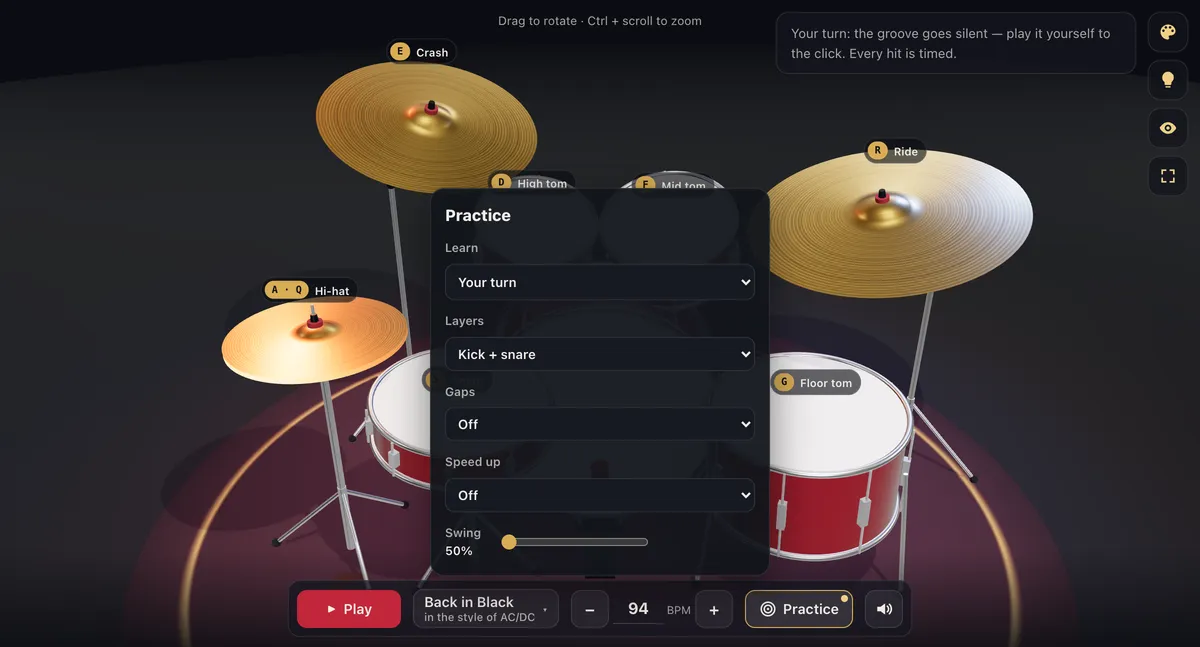
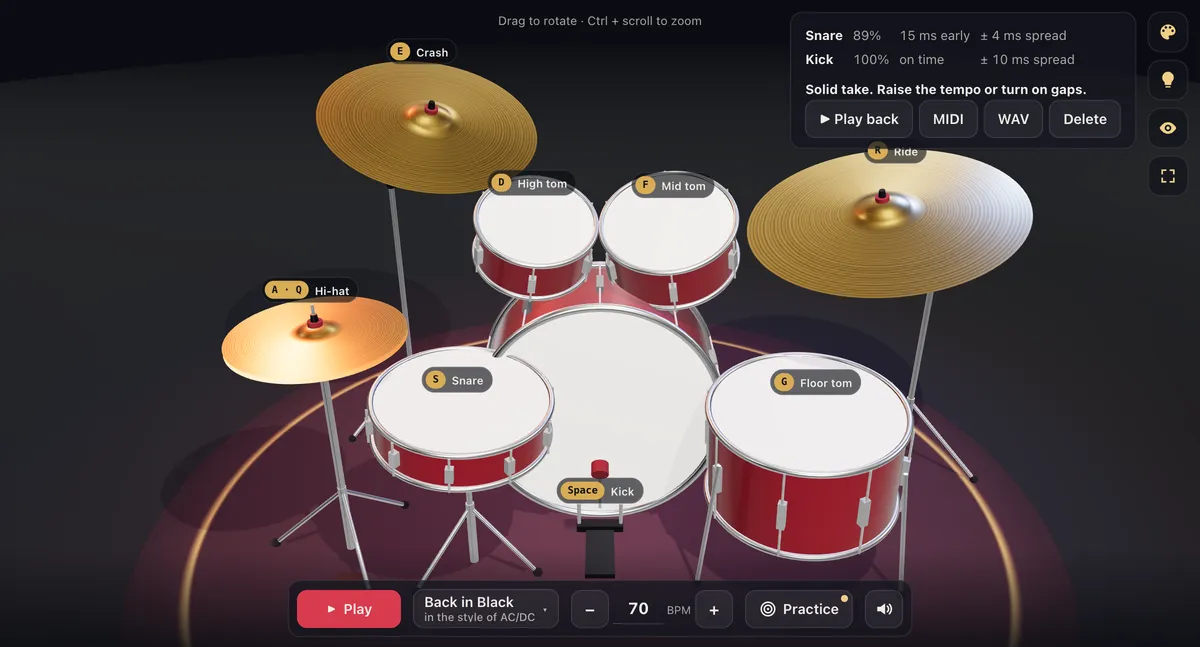
- Check: Your turn mutes the groove, keeps a click and grades every hit. "In time" means you hit a note of the groove within about a tenth of a second; missed notes lower your percentage, and extra hits are listed separately. It is an app checkpoint, not a measure of drumming ability.
- Simplify: Layers lets you play only the kick and snare first, then add the cymbals.
- Slow down: every lesson starts below the song tempo. If something falls apart, lower the tempo by 10 BPM and try again.
Day 1: count and feel the pulse
Goal: feel where the beat is and count it out loud. Song: We Will Rock You — stomp, stomp, clap, and nothing else.
- Count: press the button and count along: "1 & 2, 3 & 4". The stomps fall on "1 &" and "3 &", the clap on 2 and 4.
- Play: kick (Space) on the stomps, clap (C) on 2 and 4. On a phone, tap the bass drum for the stomps and the snare for the clap.
- Checkpoint: you can keep counting while you play, for a whole minute.
Too fast? Just count and clap your hands with the music before you touch the kit.
Day 2: the backbeat — kick and snare
Goal: kick on 1 and 3, snare on 2 and 4 — the backbone of rock and pop. Song: Back in Black, only the kick and snare.
- Count: "1, 2, 3, 4" — kick, snare, kick, snare.
- Watch, then play: follow the rings for two minutes. Keep the snare relaxed and even.
- Checkpoint: switch to Your turn, play eight bars and aim for about 80% in time.
Day 3: add the hi-hat — your first full beat
Goal: the basic rock beat: hi-hat on every 8th note ("1 & 2 & 3 & 4 &"), kick on 1 and 3, snare on 2 and 4.
- Hi-hat alone: play only the hi-hat with the groove — eight even notes per bar.
- Hi-hat + kick: add the kick on 1 and 3. Both land together.
- Hi-hat + snare: drop the kick, add the snare on 2 and 4.
- All three: loop the full beat for five minutes.
- Checkpoint: eight bars in Your turn without stopping.
If it falls apart, go back to kick and snare only, then add the hi-hat again. Building a beat in layers is normal.
Day 4: same beat, another song
Goal: notice that one pattern opens many songs. Highway to Hell uses the same simplified practice pattern as day 3 at a faster tempo. Optional extras: Smoke on the Water and Eye of the Tiger.
- Play: follow the rings at 80 BPM.
- Checkpoint: eight bars in Your turn at 80 BPM.
Day 5: keep time on your own
Goal: keep playing when the music disappears. With Gaps, some bars are completely silent — no groove and no click — and you keep playing through them.
- Start gently: 3 bars with sound, 1 silent.
- Then: 2 bars with sound, 2 silent.
- Checkpoint: when the sound comes back, you are still on beat one. The report after you stop shows whether you tend to rush or drag.
Day 6: speed up step by step
Goal: move from a practice tempo towards the song tempo without losing the beat. Speed up adds 2 BPM every four bars — in Your turn, only after bars you played in time.
- Play: start at 76 BPM and let it climb.
- Checkpoint: note the tempo where it starts to feel rushed. That is your current limit — and it moves up with practice.
Day 7: your take
Goal: eight bars of the rock beat in time, with the click only, at your comfortable tempo.
- Warm up: two minutes with the rings at 80 BPM.
- Play your take: Your turn at the tempo you reached on day 6. Every take is recorded: when you stop, play it back or save it as MIDI or WAV.
- Bonus: try 94 BPM, the tempo of the record.
Bonus: a new feel — four on the floor
Ready for more? Move your feet and hands to a dance beat: the kick on every beat, the snare still on 2 and 4, and an open hi-hat on every "&". Try the simplified groove in the style of Poker Face at 90 BPM, then compare it with day 3: same snare, a completely different groove.
What this plan does not teach
Playing with fingers and keys trains counting, listening and coordination of rhythms. It does not teach how to hold sticks, how they rebound, how to work the bass drum and hi-hat pedals, or how to sit at a kit. When you get behind a real or electronic kit, expect the same beats to feel new for a while — that is normal. A teacher, or a good beginner lesson on grip and posture, is the best next step.
How long does it take to learn drums?
It depends on how often you practise and what you want to play, so think in milestones rather than a fixed number of weeks:
- Count and keep a steady pulse.
- Play the basic rock beat in time — the goal of this plan.
- Change between a few beats and add simple fills.
- Play through complete songs with their sections, changes and endings.
- Play with other musicians and read drum notation.
Regular, manageable sessions move you through these steps more steadily than occasional long ones.
Where to go next
- More songs on the same pattern: the basic rock beat page.
- New patterns, step by step: easy drum beats.
- Write your own groove: the drum machine.
- How fast songs really are: the most common BPM.
FAQ
Can I learn drums without a drum kit?
You can learn to count, keep time and play the basic beats with your fingers or a keyboard, as in this plan. Stick technique, pedal control and posture need a real or electronic kit.
How long does it take to learn drums?
It depends on how often you practise and what you want to play. Steady time and the basic rock beat come first; full songs, fills and playing with others come later.
What should my first drum lesson cover?
Counting out loud, a steady pulse, and the backbeat: kick on 1 and 3, snare on 2 and 4. Add the hi-hat once those feel easy.
How many minutes a day should a beginner practise drums?
Short, regular sessions are easier to keep up than rare long ones. This plan uses about 15 minutes a day.